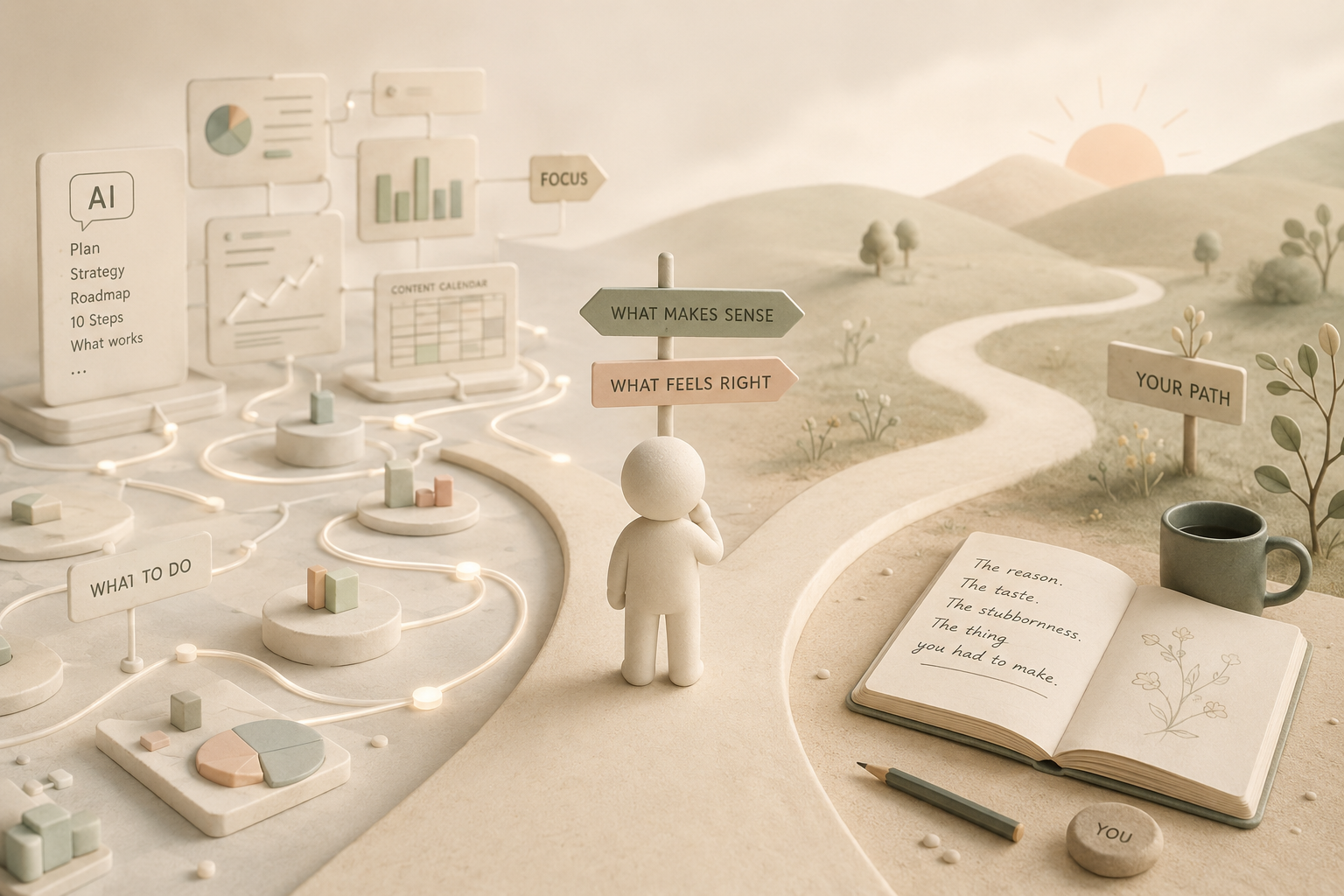
AI can give you ideas. It can also steer you more than you realize.
Everyone’s asking AI to build them a business now. I know, because I did it too.
Type in the dream, get back a plan. A strategy. A content calendar. A “10-step roadmap to your first $10k.” It feels like a door opening — like the hard part just got outsourced. And for a lot of people, that’s what AI has quietly become: a business coach that never sleeps, always encouraging, always with an answer.
I don’t want to be cynical about this. AI is genuinely useful. It’s fast, it’s knowledgeable, it can think through a problem with you at 2am when no one else is awake. I’ve used it constantly while building my own thing, and it made me better at it.
But here’s what I learned the hard way.
It will have an opinion about your life
I’d have an idea — start a YouTube channel, open an Instagram account, try a new platform — and I’d bring it to the AI. And most of the time, it would talk me out of it. Not rudely. Reasonably. With good arguments: you’re trying to do too many things at once, focus on what’s working, that’s a distraction from the real problem.
And every time, I listened. I ran the reasoning through my own filter, decided it made sense, and stopped.
What I keep wondering is this: what if I was wrong to listen?
Maybe if I’d opened that YouTube channel anyway, one video would have landed. Maybe trying five platforms wouldn’t have been a mistake — maybe it would have been how I found the one that worked. Or maybe the AI was right. That’s the honest answer: I don’t know. What I do know is that I let a very reasonable-sounding argument override an instinct I actually had.
That’s the part nobody warns you about. AI doesn’t just answer your questions. It’s persuasive. It’s calm, consistent, and it always has a rationale. And that steadiness can quietly overwrite the thing that was pulling at you before you asked.
The part it can’t do
An AI can tell you what usually works. It cannot want your business.
It doesn’t know what it feels like to make the thing. It doesn’t know which part of the work makes you come alive and which part makes you want to close the laptop. It doesn’t carry the reason you started. It can generate a plan for your dream, but it has no stake in whether the dream happens.
There’s a simpler problem too. Everyone is asking the same AI the same questions. If you and a thousand other people type in the same dream, you get back roughly the same plan. AI is trained on what usually works — which means it hands you the average of everything that already exists. Your business can’t be different if its blueprint isn’t. The only thing in the room that isn’t average is you.
And that matters more than you’d think — because a business built entirely on borrowed conviction is fragile. When it gets slow (and it will get slow), the only thing that keeps you going is the part that was yours: the reason, the taste, the stubbornness, the thing you had to make.
You can’t outsource that. And if you try — if you hand over not just the tasks but the wanting — you end up with something efficient and hollow, and you wonder why finishing it feels like nothing.
So use it, but stay in the driver’s seat
Ask it things. Argue with it. Let it challenge your thinking, catch what you missed, do the boring parts. It’s very good at all of that.
But when it tells you not to do something, and something in you still wants to — pause on that. The instinct might be noise. Or it might be the one piece of information the model doesn’t have: you.
Trust your own read first. Then let the tool sharpen it.