Three visits yesterday. One the day before. You refresh your stats the way you’d check a weather app that only ever says “cloudy” — hoping, this time, the number moved.
It’s a specific kind of lonely, running an Etsy shop nobody walks past.
More isn’t the answer
The standard advice for invisibility is to produce your way out of it: more listings, more tags, more posts, another SEO tutorial at midnight. The logic feels sound — more surface area, more chances to be found.
But surface area only helps if you’re standing somewhere people are already looking. Forty listings on a street nobody walks are still forty invisible listings. And often the street isn’t empty — it’s crowded. Dozens of shops sell something nearly identical to yours, and a forty-first listing just adds one more shelf to a store that already has ten thousand.
So before adding more, it’s worth asking a different question — not “how do I make more?” but “why can’t the ones I have be found, and is being found even the real problem?”
The symptom is not the constraint
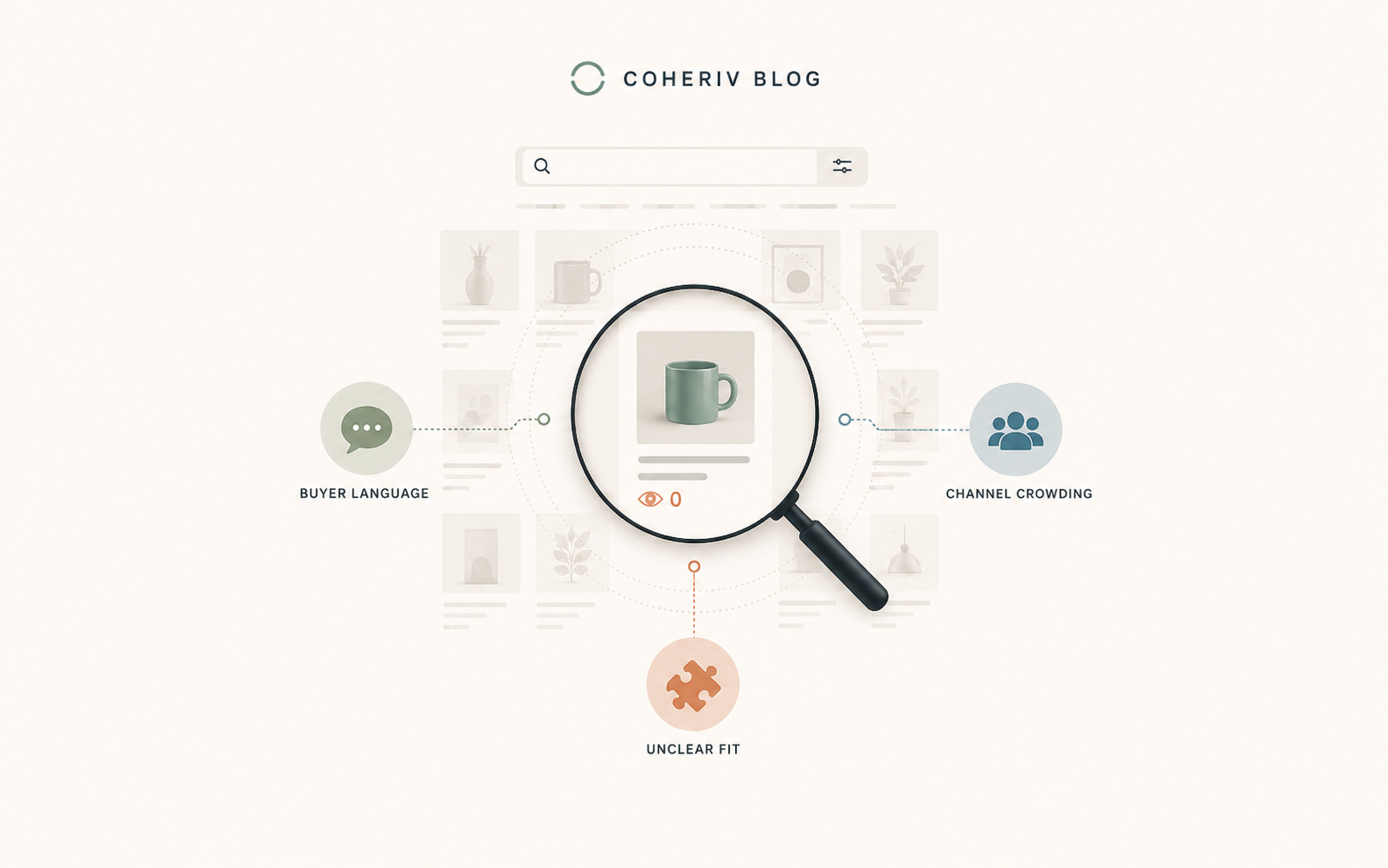
“No views” is the symptom — the flatline on the graph. But underneath it, invisibility usually has one of three causes. They feel identical from the inside. They need opposite fixes. And most sellers spend months on the wrong one, because from inside your own shop you can’t tell them apart.
That’s the real difficulty. Not that you don’t know how to add a tag — you do. It’s that all three causes feel like the same blank wall.
Here’s how to tell them apart.
Maybe you’re speaking your language instead of the buyer’s.
Open a private browser and search for your product the way you describe it. Now search the way a stranger would — plainly, in the words they’d actually type. If your listings appear for your words and vanish for theirs, you’ve named your work in a dialect your customer doesn’t speak.
Maybe you’ve bet everything on one crowded channel.
Look at your traffic sources. If nearly all your visits come from marketplace search in a busy category, you’re one shelf among thousands — visible in theory, buried in practice. The absence of any outside source — no Pinterest, no email, no small community that already knows you — is itself the finding.
Maybe you’re findable, but not clearly for anyone in particular.
Look at the strongest shops in your exact niche. If dozens of them sell something close to yours, the buyer scanning results isn’t choosing on visibility — they’re choosing on which one is obviously for me. And if nothing about your listing answers that, more views won’t help. Being seen and being chosen are not the same thing.
Quick check: which one is yours?
| If this is what you see | The likely constraint |
|---|---|
| You appear for your own product words, but vanish for how a stranger would search | Language mismatch — you’re speaking your words, not the buyer’s |
| Almost all traffic depends on Etsy search alone | Channel dependency — one crowded shelf, no outside door |
| You get views but weak clicks or sales, and rivals look near-identical | Fit / positioning — findable, but not clearly for anyone |
| Competitors look the same as you but have far more reviews | Trust + positioning — you lose the numbers race on a shared shelf |
If more than one feels true, that’s normal — they overlap. What matters is which one is first.
Why the third one is different
The first two have tidy fixes — better words, a second channel. The third doesn’t, and that’s exactly why it gets missed.
If the real issue is that you’re findable but not clearly for anyone, then “get more visible” is the wrong goal. It just sends more people past a listing that doesn’t feel meant for them. The break isn’t in how you’re found — it’s one link earlier, in who you’re unmistakably right for.
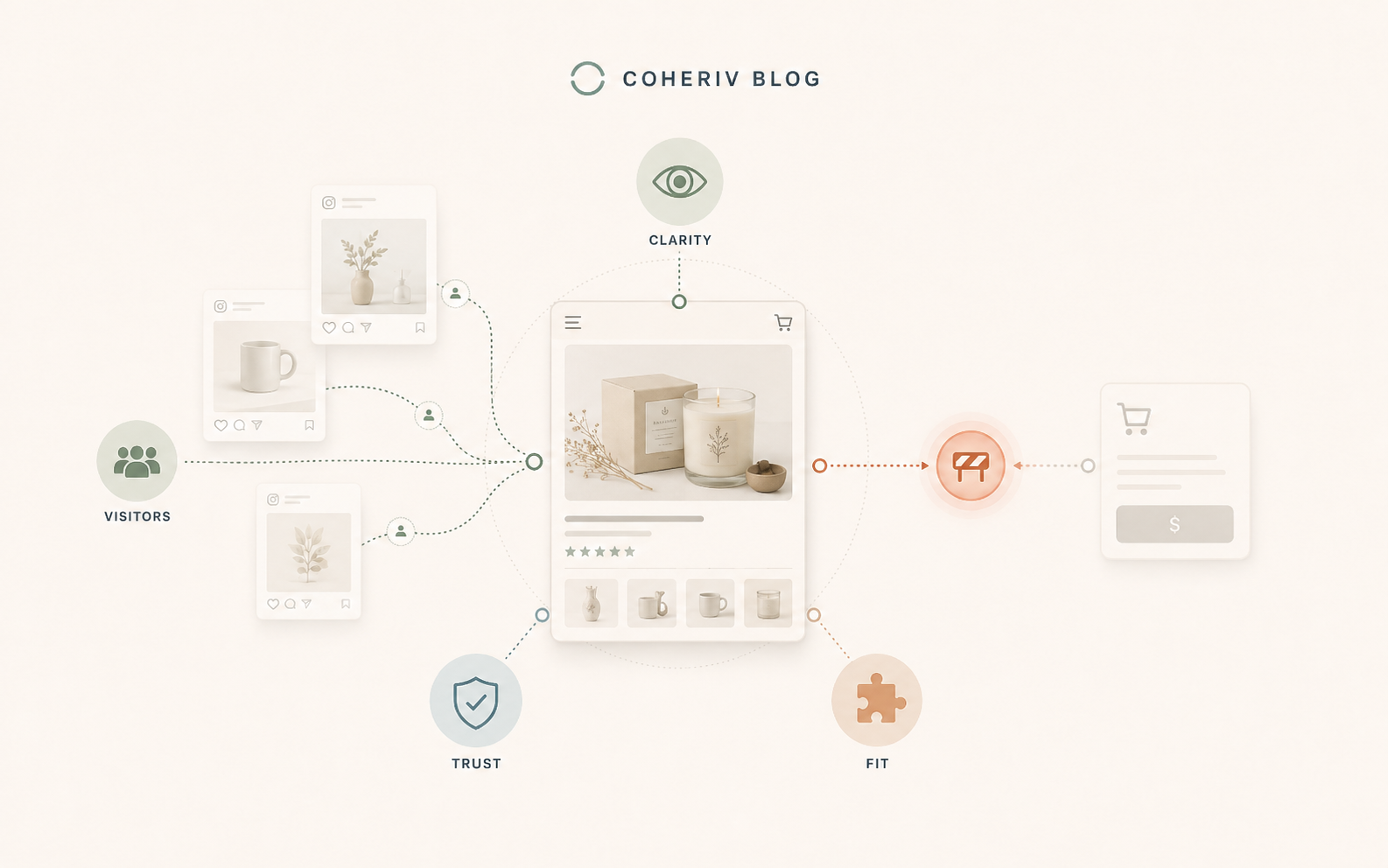
That’s the shift a systems view gives you. A sale runs down a chain:
find you → understand you → trust you → buy
“No views” looks like the very first link is broken. But often that link is fine, and the real gap sits just behind it: you haven’t yet pinned down the one person this is truly for. Define that, and being found gets easier on its own — because now a specific person is looking for exactly what you’re the clear answer to.
There’s a quieter reason this matters in a crowded category. When shops look alike, buyers fall back on numbers — they pick the one with the most reviews, the most sales, the loudest proof, because in a crowd, trust gets measured in totals. You can’t win that race as a newer shop. You will never out-review the thousand-review listing, and pouring effort into trying is its own kind of working on the wrong link.
But that race only runs on the same shelf. The moment you’re clearly the one for a particular person, you stop being compared on review count against a generalist. A thousand reviews on a “for everyone” product weighs less, to the right buyer, than being unmistakably for them. So even trust, chased directly, tends to loop back to the same earlier link: not louder proof, but a clearer who.
Working on visibility while that link is unclear is effort spent one rung below where it counts. It produces visible output — new listings, new tags — so it feels like the right work. And it quietly moves nothing.
What this looks like in real life
A seller of digital planners built something genuinely good and branded it “FlowOS.” Clean design, proud name — and near-zero impressions, month after month. She kept refining the product, sure quality would eventually surface it.
Some of that was fixable at the surface: nobody searches “FlowOS,” so she re-anchored the listing around words people actually type. Impressions began to move. But sales didn’t follow — because the planner still sat in a category full of capable, near-identical ones, and nothing said this one, for you.
The fix wasn’t a niche or a smaller product. It was getting specific about the one person it was truly for — someone drowning in open-ended tools, who needs time-blocking and a daily structure — and rewriting a single listing to speak only to them. Same planner. Same breadth. It just finally stood in front of a particular person as the obvious answer, instead of in front of everyone as one option among ten.
That’s the move a crowded category asks for. Not louder. Not smaller. Clearer about who it’s for. And you can’t find that by staring at your view count — only by seeing which link in the whole chain is quietly the loose one.
Why this matters
Invisibility is uniquely demoralizing because it gives you no information. With traffic and no sales, at least something is talking to you. With no traffic, you’re guessing in silence — and most sellers respond by working harder on the product, or louder on the keywords, which are often the two things the real constraint isn’t about.
The seller who gets unstuck usually isn’t the one who found a better tag. It’s the one who stepped back far enough to ask whether visibility was even the right fight.
So before you write another listing, ask this
Not “how do I get seen?” but: if my ideal buyer typed exactly what’s in their head — their words, their need — would my shop appear, and would it look clearly meant for them?
If the honest answer is “findable, but not clearly for anyone,” more visibility won’t fix it. A clearer sense of who it’s for will.
Not sure visibility is your real constraint?
Low views often trace to something upstream — most often a fit problem, where being findable to no one in particular looks exactly like being invisible. The free Coheriv snapshot reads your business as one system and shows you which link is actually first, so you stop pouring effort into the rung below the broken one.